Flour on the Table, Room to Talk: Grandmother-Granddaughter Cooking Hours in Ataşehir
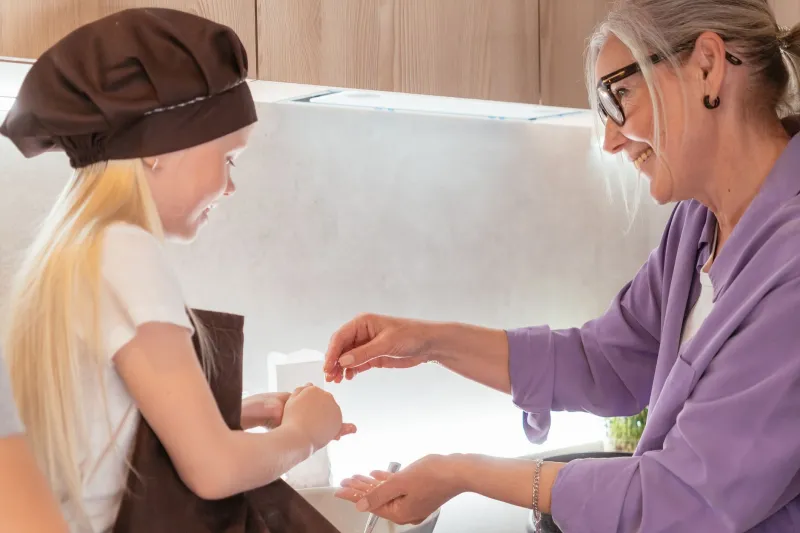
On a Sunday morning in Ataşehir, a kitchen table disappears under bowls. There is flour in a shallow dish, a pot of lentil soup cooling by the window, and a grandmother who is pretending not to supervise. Her granddaughter is twenty-six, has a full-time job, and is learning—again—how to fold a dolma leaf tight enough to hold its shape. The phone is face-down. Nobody has said the word 'bonding.' That is exactly why it works.
Across Ataşehir, grandmother-granddaughter cooking pairs are not a formal program. They are an ordinary rhythm: a weekly börek, a batch of stuffed vegetables, a jar of tomato sauce put up before the season turns. But talk to the women who keep this rhythm and a quieter benefit surfaces. The kitchen becomes a low-pressure room for connection, a place where no one has to make eye contact to say something real.
To protect privacy, I'm blending a few afternoons into one portrait and using first names only. The pair I'll call Nur and Elif live ten minutes apart. Nur is seventy-four and has cooked in the same neighborhood for decades. Elif is twenty-nine and moved back to Ataşehir after a few years away. They started cooking together on Sundays because Nur's knees made long market trips harder and Elif wanted to learn the recipes she remembered from childhood. What began as a practical arrangement became something neither of them had planned: a standing appointment that neither wants to cancel.
The kitchen as a low-pressure room
There is a reason kitchen conversations go sideways—literally. When your hands are busy, you are not performing attention. You are beside someone, not across from them. That can make it easier to say the awkward thing: work is draining, rent is high, a friendship has gone quiet, a grandmother is lonely but does not want to say so directly.
Nur tells me she likes having a job that is not 'checking on' her granddaughter. Elif says the cooking gives her permission to ask about family history without making it a formal interview. The recipe is the excuse. The conversation is the point.
What the pairs actually do
The work is not glamorous. There is onion chopping, rice rinsing, parsley picking, and a lot of waiting. One person rolls; another stirs. Someone remembers which pot is for the neighbor. Someone else figures out how to order the missing ingredient on a phone. The roles shift. The grandmother is the expert on technique. The granddaughter is often the expert on logistics, translation, or the grocery app.
That exchange matters. It keeps the older woman in the position of teacher, not patient. It gives the younger woman a sense of roots that does not require a big emotional speech. And it creates a shared task that can absorb silence. Not every minute needs to be filled with revelation. Some minutes are just garlic.
Why it helps family mental health
Shared cooking does not cure loneliness, anxiety, or depression. It is not a substitute for professional care. But it can build the kind of everyday connection that protects family mental health: regular contact, a sense of usefulness, a routine that pulls people out of isolation, and a relationship that is not only about problems.
For older adults, feeling needed matters. For younger adults, feeling rooted matters. For families in between, the kitchen can become a neutral zone where nobody has to be the perfect daughter, mother, or granddaughter. You are just the person who remembered to salt the water.
Borrowing the ritual in a US kitchen
US families do not need a Turkish grandmother or a full day of rolling dolma to borrow this. They need a realistic container. Sunday afternoon is a good one because it is already a transition day: not as scheduled as Monday, not as loose as Saturday. A forty-five-minute prep session is enough. The goal is not a beautiful meal. The goal is a shared task with a beginning and an end.
Pick one hands-on dish and one background dish. The hands-on dish gives people something to do: dumplings, stuffed peppers, a tray of enchiladas, a big pot of soup with vegetables to chop. The background dish can simmer while you talk. If a grandmother, mother, aunt, or older neighbor lives far away, set up a video call and cook the same recipe at the same time. It is not the same as being in the same room, but it is better than another text that says 'we should catch up.'
A simple Sunday prep plan
- Choose one recipe that has a repetitive task. Repetition is what makes conversation possible.
- Shop for the ingredients together, or split the list so one person brings the produce and the other brings the pantry items.
- Put phones in a bowl for the first thirty minutes. Not forever. Just long enough to break the scroll reflex.
- Assign a task to every age. Even a young child can wash herbs or count eggs. Even a grandmother who tires easily can sit and direct the folding.
- Pack half the food for the week. The point is not to cook all day. The point is to make the ritual repeatable.
Conversation prompts that don't feel like an interrogation
Skip 'How are you?' if you want a real answer. Try something smaller and more specific.
- 'What did you cook when you first lived on your own?'
- 'Who taught you this recipe, and what did they get wrong?'
- 'What is one thing that felt hard this week?'
- 'What is one thing you are looking forward to?'
- 'What should I know how to make before I teach someone else?'
These prompts work because they are attached to the task. You are not sitting someone down for a wellness check. You are asking across a bowl of parsley.
The point isn't the börek
The börek is good. The soup is good. But the real reason Nur and Elif keep showing up is not the food. It is the standing date. It is the knowledge that someone expects you in the kitchen, with your hands free and your phone down, for an hour that belongs to neither work nor worry.
US families can borrow that without recreating an Ataşehir Sunday exactly. Keep the task simple. Invite the person who is too often checked on and not often asked to teach. Let the conversation arrive sideways. If someone is struggling with persistent low mood, anxiety, or isolation, connect them with a clinician. But do not underestimate the quiet support of a shared pot, a standing time, and a grandmother who is pretending not to supervise.