Seven Small Rituals From Turkish Homes That Quietly Take the Edge Off Family Life
Every family has a nervous system, and most of them are running hot. Between school pickup, work Slack, and the eternal question of what's for dinner, the average American household operates like a small company with no HR department.
The fix usually isn't bigger. In Turkish homes, the things that hold a family together tend to be almost embarrassingly small — a glass of tea, a walk to the market, a proper goodbye at the door. Anthropologists call this “family ritual”; the rest of us just call it Tuesday.
Here are seven worth stealing. Each one is free or close to it, and each comes with a note on making it work on an American schedule.
1. The Afternoon Tea Pause
In Turkish homes, çay arrives without ceremony and without an occasion. Someone puts the kettle on, the small tulip glasses come out, and for ten or fifteen minutes nobody is doing anything productive. It's not a break from the day so much as a hinge in the middle of it.
Why it works: Ritualized pauses function as built-in stress recovery. The predictability itself is regulating — your body learns when the next exhale is coming. Research on micro-breaks consistently finds that short, intentional rests restore attention better than pushing through.
Make it American: Swap the tea if you like; the point is the glass and the sitting. Put the phone in another room. Keep it under fifteen minutes so it stays a pause and not an event. If afternoons are impossible, most families find a 7 p.m. version works just as well — decaf, same idea.
2. The Saturday Market Walk
Turkish families shop the pazar on foot, weekly, arguing gently about tomatoes. It's shopping, exercise, and social life braided into one errand.
Why it works: Walking while doing something else sneaks movement past the part of your brain that resists exercise. Seasonal, whole-food shopping also tends to make meal decisions easier later in the week — what's good at the market becomes what's for dinner.
Make it American: Find the nearest farmers market and go weekly, even if you only buy one thing. Assign a kid the job of picking the fruit. If a market isn't nearby, the produce aisle plus a walk around the block does a surprising amount of the same work.
3. Setting the Table Together (the Sofra Habit)
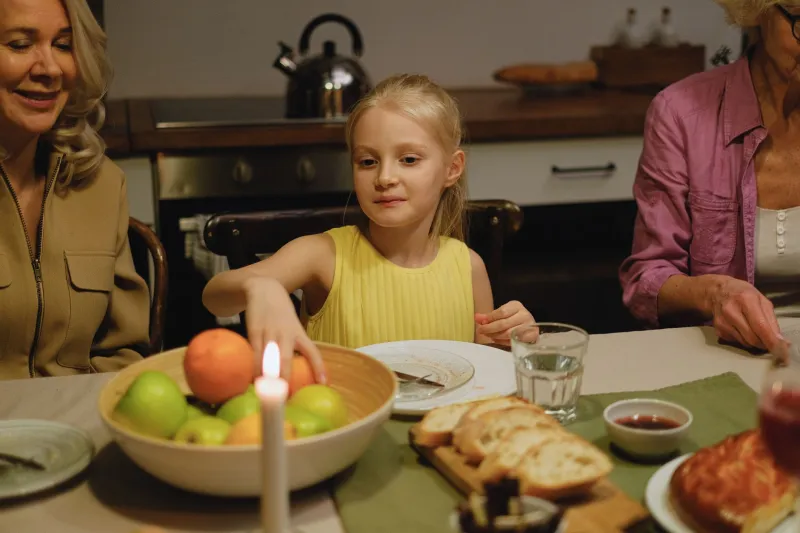
A Turkish table is laid by several hands, and the laying is part of the meal. Plates, forks, a little dish of something pickled, a stack of bread. Nobody eats standing over the sink by accident, because the table announces itself.
Why it works: Shared family meals are one of the most consistently supported findings in family research, linked to better emotional outcomes for kids and less isolation for adults. The ritual of setting the table is what makes the meal happen on autopilot.
Make it American: Lower the bar. Paper plates are fine. What matters is that dinner has a shape — same table, same time-ish, everyone arrives. If sports schedules make that impossible four nights a week, protect two and let the rest go.
4. The Kitchen Brigade
In Turkish households, cooking is rarely a solo performance. A grandmother trims beans, a kid stirs, someone else washes up, and the whole thing takes longer than it would alone — and is better for it.
Why it works: Multi-generational time in the kitchen gives children real competence, gives older adults a genuine role, and gives everyone a shared project that doesn't require conversation. That's a low-pressure form of connection, which is often the kind that actually sticks.
Make it American: Pick one meal a week as the group project. Give the youngest a knife-free job and the oldest the job of teaching it. Dietary preferences are easy to fold in here — the ritual is about hands, not ingredients.
5. The Neighbor Plate
When a Turkish family makes something good — börek, a tray of cookies, a pot of soup — a portion goes next door. Not as a favor, exactly. More as a form of bookkeeping.
Why it works: Sociologists describe these exchanges as the small change of community — low-stakes gestures that build the kind of relationship you can call on later. They also give the giver something to do with abundance, which is its own quiet good.
Make it American: You don't need a recipe. Extra muffins, half a watermelon, a bag of tomatoes from the market walk. Include a sticky note so it doesn't feel weird. Do it for the same two neighbors consistently and the whole street changes temperature.
6. The Doorway Goodbye
Turkish departures are famously long. You stand at the door. You say goodbye. You say it again. Someone says “come again” and means it.
Why it works: Rites of arrival and departure mark transitions, and transitions are where families tend to lose each other — the rushed morning exit, the wordless evening return. A deliberate goodbye or greeting takes eight seconds and gives the day a seam.
Make it American: Pick one transition to ritualize. A real hug at the door in the morning instead of a shout from the kitchen. A two-minute sit-down when someone gets home. Skip the long farewell — your version can be short. It just has to be consistent.
7. The Small Occasion Rule
Turkish family life is studded with minor celebrations — a new job, a first day of school, a visitor arriving from out of town. Nothing gets past without a plate of something and a bit of fuss.
Why it works: Anticipating and savoring small good things is strongly associated with positive mood, and it costs nothing. Big vacations deliver a burst; small celebrations deliver a rhythm.
Make it American: Keep a running list on the fridge of things worth marking — a finished semester, a driver's license, a Tuesday that was unusually hard. Celebrate with the same thing every time so it stays easy: a specific cake, a specific takeout order, a specific song. Repetition is what turns a treat into a tradition.
Start With One
Seven is a nice number for an article and a terrible number for a household. Pick the one that made you exhale slightly when you read it, and do it for three weeks. If it survives three weeks, it's yours.
The families who feel calmest aren't the ones with the most routines. They're the ones whose routines are small enough to keep.